
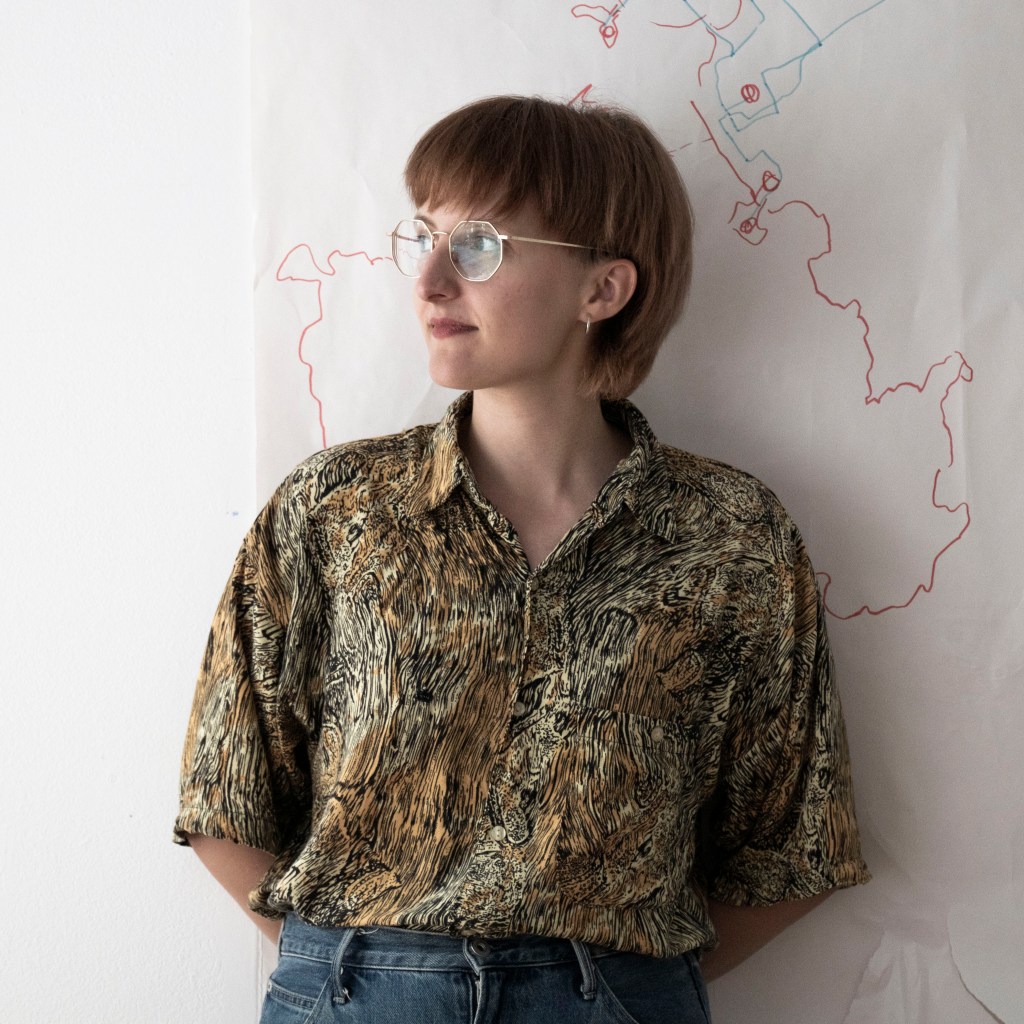
Short Q&A with our artist in residence Hannah Hoebeke, who’s time with us has come to an end.
Q1: What influences your work?
A1: My work is strongly influenced by encounters with people. I use sculpture to facilitate these encounters, the act of sculpting itself becomes a platform for conversation, a way to get to know another person’s world, someone I wouldn’t normally come into contact with.

Q2: Have you noticed something new in your practice during your residency at Platform?
A2: During my residency at Platform, I wanted to challenge my practice around accessibility. I often work with groups who don’t have direct contact with the art world, and I wanted to push that accessibility further by making my practice hyper-mobile, so people wouldn’t have to feel the threshold of a gallery, but instead I could meet them in a place that matters to them, where they feel comfortable. That’s how I started developing a sculpting trolley that fits on my bike, is lightweight, and can be disassembled, so I could bring the project directly to people.

Q3: Have you learned something new during your residency?
A3: The residency was a new step for me in terms of engaging people in dialogue based on location. In the past, I would start conversations at someone’s workplace or in the studio, but this time, because I could be so mobile, I started the dialogue before the encounter even began, by asking people to take me to a place that mattered to them. That immediately opened up the conversation, and through this approach I was able to create a subjective map of Vaasa.

Q4: What questions or themes are you currently working with?
A4: I’m working strongly around the role of community work within the art world, and how we can make it genuinely accessible — but also around the role of sculpture, which historically served as a propaganda tool for the ruling class. I’m interested in transforming that away from emperors and kings, and instead using the status of sculpture to represent unseen communities and labor.

Q5: How did the change of environment influence your work?
A5: Until now I’ve worked mostly in urban environments. In Vaasa, I quickly noticed that people were drawn much more into nature, and wanted to bring me to those places too. That was a real challenge for me, and resulted in designing a mobile sculpting setup that could handle it. It also pushed me, for the first time, to build an exhibition around elements of nature: the bike that carried me to everyone’s chosen place, and a mountain of portraits forming a collective map of Vaasa that follows the shape of the trolley on the back of my bike.


Leave a Reply